 von
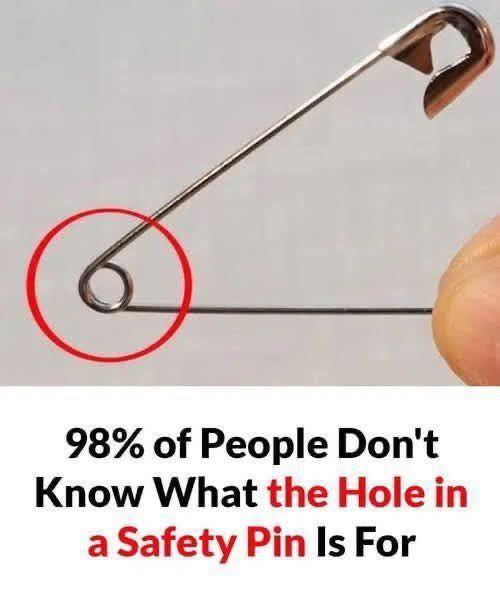
At first glance, a safety pin is one of the most unassuming objects you can find in a household. It’s small, metallic, and doesn’t seem to have changed much in over a century. But if you look closely, you’ll notice something peculiar—a tiny hole near the head of the pin.
Why is it there? Is it just a manufacturing quirk? A design leftover? The answer may surprise you. That little hole serves multiple purposes that make the safety pin far more ingenious than most people ever realize.
Let’s take a deep dive into this underrated feature—and discover how a tiny detail can transform a simple tool into a multi-functional lifesaver.
The Birth of the Safety Pin: Simplicity Meets Brilliance
The safety pin was invented in 1849 by American mechanic Walter Hunt, who needed to pay off a $15 debt. What he created, however, was worth much more—a coiled, spring-loaded pin with a clasp that could fasten fabric without stabbing the user.
It was safer, reusable, and incredibly effective. Over time, it found its way into households, hospitals, military kits, fashion runways, and DIY supply boxes across the globe. But even the best designs can improve—and that’s where the tiny hole comes in.
A Hole With a Purpose: Function Over Form
While the body of the safety pin secures fabric, and the clasp keeps fingers safe, the tiny hole near the head serves a surprising range of functions. It’s not just a design flourish. It’s a deliberate choice rooted in usability.
Let’s break it down.
1. Thread Anchor for Sewing & Crafting
Have you ever struggled with holding thread in place while sewing or crafting? That small hole can become your best friend.
- Basting Layers of Fabric: Pass the thread through the hole and use the pin to guide it precisely across multiple layers of fabric.
- Threading Buttons & Beads: If your fingers are too big or the opening too small, the safety pin becomes a handy threading tool.
- Securing Ribbons or Strings in DIY Projects: Attach the end of your ribbon to the hole, making it easier to weave or attach decorations.
Fun Fact: Some quilters and tailors prefer safety pins with holes because they can double as precision thread tools without damaging fabrics.
2. The Emergency Button Trick
Lost a button at the worst time—like five minutes before a meeting or on your commute? Don’t panic.
Simply slip the safety pin through the buttonhole and use the tiny hole to secure it discreetly to the inside of the garment. It’ll hold the fabric together until you can sew on a proper button.
Pro Tip: If you keep one in your bag or wallet, this little trick can save your outfit (and your day).
3. Mini Hanging Hook for Lightweight Objects
Need to attach something to a bag or lanyard? That hole acts as a miniature keyring.
- Hang lightweight keys or charms.
- Loop ID tags or name badges.
- Create makeshift bag clips or closures.
With some string or wire, you can even turn a safety pin into a small but functional jewelry hook or zipper pull.
4. Medical Marvel in Miniature
In emergencies, improvisation saves lives—and the humble safety pin is often included in first aid kits for this reason. That tiny hole makes it even more versatile in medical settings.
- Secure gauze or bandages: Thread fabric through the hole for a tighter, non-slip hold.
- Anchor a tourniquet or sling: In a makeshift scenario, you can use the hole to tie fabric securely in place.
- Splint stabilization: Use safety pins and thin rods (like pencils) to stabilize fingers or toes in the field.
It’s proof that something small can be absolutely essential when seconds count.
5. Jewelry Repairs Made Easy
If you’ve ever had a bracelet chain snap or an earring lose its hook, you know how annoying jewelry malfunctions can be. Enter: the safety pin’s secret weapon.
Use the hole as a manipulation point to:
- Hold fine wires while soldering or twisting.
- Guide thread or elastic through beads or loops.
- Secure unfinished chains during design.
For small repairs, the safety pin acts like a third hand—and the hole gives you better grip and control.
6. Creative DIY Uses You’ve Never Considered
Sometimes, the best uses are the ones nobody ever told you about. Here are some clever, lesser-known applications of that tiny hole:
✔ DIY Keychains
Thread a cord or metal ring through the hole to create a functional, pocket-sized keychain that won’t damage your clothes.
✔ Embroidery Hack
Use it to pull embroidery floss through thick denim or canvas without snagging or tearing the fabric.
✔ Zipper Pull Substitute
Broken zipper tab? Loop a safety pin through the hole and attach it to the zipper head. Instant fix.
✔ Wedding Dress Savior
Tailors often use safety pins to hold delicate garments in place without puncturing visible areas—by anchoring thread through the hole instead of pinning directly into fabric.
A Small Design With a Big Impact
The inclusion of a tiny hole might seem insignificant, but it reflects the core principles of smart design:
- Anticipate user needs
- Add value without adding complexity
- Increase function without increasing cost
It’s an elegant reminder that even simple tools can evolve in subtle but meaningful ways.
Just think: the next time you use a safety pin, you might not even use the sharp end—but the hole instead.
Marketing Genius: Minimal Design, Maximum Utility
Manufacturers don’t advertise the hole—it’s not even mentioned on most packaging. And yet, it increases the pin’s value dramatically.
In the age of over-engineered gadgets, the safety pin remains a masterclass in minimalism. Every curve, every coil, and yes—even that tiny hole—serves a purpose.
And the best part? You probably already own a dozen of them.
Final Thoughts: A Hidden Hero of Everyday Life
From fixing clothes to saving the day during emergencies, the safety pin proves that size isn’t everything. And that tiny hole?
It might just be the most underappreciated innovation in your entire home.
So next time you come across a safety pin, take a second to appreciate its full design. Because it’s not just a pin—it’s a problem-solver, a lifesaver, and a tiny masterpiece of engineering.